

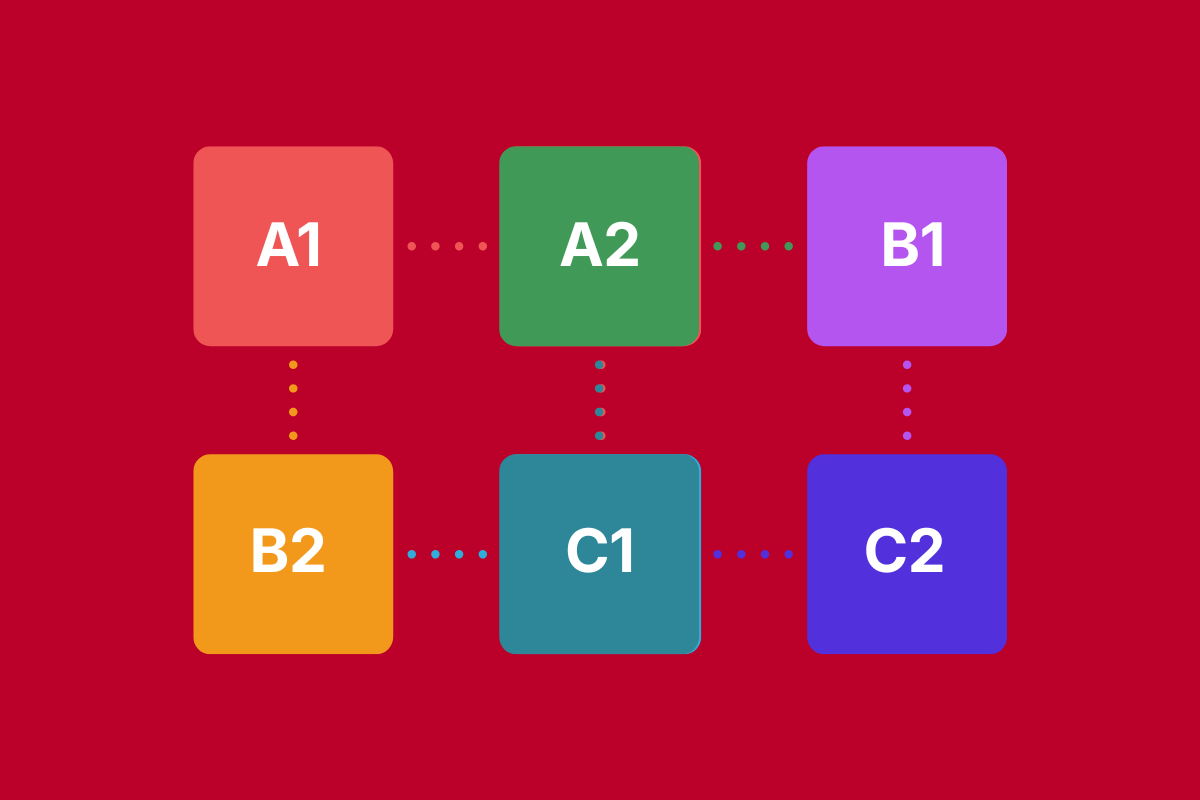

Are you learning French and want to accurately determine your level? The Common European Framework of Reference for Languages (CEFR) is now the international standard for assessing language proficiency. It defines six levels, from beginner (A1) to proficient user (C2).
In this article, we help you better understand these levels, identify your own, and discover practical ways to improve effectively.
French levels: what do they cover?
Your level in French corresponds to your ability to use the language in a variety of situations. It is assessed based on five key skills:
- listening comprehension
- reading comprehension
- spoken production (continuous speaking)
- spoken interaction
- writing
The CEFR organizes these skills into three broad categories — A (basic user), B (independent user), and C (proficient user) — each divided into two levels. This framework is detailed by Eduscol, the national portal for education professionals.
2. From A1 to C2: benchmarks and skills
Each level corresponds to concrete, observable abilities in real communication situations.
| A1 (beginner) | You communicate in a simple way in very common situations |
| A2 (elementary) | You handle basic everyday needs |
| B1 (intermediate) | You discuss familiar topics and describe personal experiences |
| B2 (upper intermediate) | You argue, develop your point of view, and interact with ease |
| C1 (advanced) | You express yourself fluently and understand complex content |
| C2 (proficiency) | You use the language with precision and nuance in all contexts |
These levels provide a structured progression to support learners.
A1 – Beginner (introductory/discovery)
You communicate about very simple topics. You introduce yourself, ask for basic information (a price, directions), and understand slowly spoken sentences.
Example: “Bonjour, je m’appelle Maria, je suis espagnole, j’habite à Lyon.”
A2 – Elementary
You handle everyday situations: shopping, taking the bus, making a medical appointment. You describe your environment simply and express basic opinions.
Example: “Je voudrais un rendez-vous pour vendredi matin, c’est possible ?”
B1 – Intermediate (threshold)
You can hold simple conversations on familiar topics (work, school, hobbies). You describe past experiences, understand everyday texts, and express feelings. This is the minimum level recommended for working in France.
Example: Expliquer un problème à son employeur ou raconter ses vacances à un collègue.
B2 – Upper intermediate (independent)
You are comfortable in most situations. You argue your ideas, express nuance, and follow lively conversations between native speakers. You understand complex texts, including technical ones.
Example: Participer activement à une réunion professionnelle ou rédiger un rapport structuré.
C1 – Autonome (expérimenté)
You express yourself clearly and effortlessly. You understand long and demanding texts, grasp implicit meanings, and master different registers (emotional, implicit, humorous).
Example: Animer une présentation universitaire, écrire un article d’opinion détaillé.
C2 – Proficiency
You understand almost everything, even highly implicit written texts. You express yourself with great precision, convey subtle nuances, and produce sophisticated written work in a fluent style.
Example: Traduire un texte juridique complexe ou rédiger un roman.
How to assess your French level
Before enrolling in a course or preparing for certification, it is recommended to assess your level.
Several complementary approaches exist:
- Online tests provide a quick initial assessment, particularly in grammar and vocabulary. RFI Français Facile notably offers practice for the oral sections of the DELF and TCF under exam conditions. However, they do not assess your speaking level or your pronunciation.
- Assessment by a qualified teacher of French as a Foreign Language (FLE) remains the most reliable method: it takes into account all your skills, both spoken and written. The teacher can then provide you with a personalized learning plan. The Alliance Française de Lyon offers assessments either in person or remotely, in group or individual classes.
A precise assessment helps define a learning path tailored to your goals.
4. Making progress in French: a structured approach
Language learning relies primarily on consistency and practice. Effective progress is based on key principles:
- practice speaking daily, even for short periods
- build useful vocabulary in context
- strengthen grammar foundations
- regularly expose yourself to the language (audio, video, reading)
- receive feedback and corrections
Structured guidance helps optimize progress.
Here is an article provided by our teaching department on how to learn French quickly.
5. Choosing a course suited to your level
Your choice of course depends on both your current level and your goals: daily life, studies, professional integration, or exam preparation.
| Level | Teaching priorities | Goals |
| A1-A2 | Basics, pronunciation, practical situations | Daily life and integration |
| B1 | Guided conversation, confidence in speaking | work, travel |
| B2 | Fluency, argumentation, professional vocabulary | university, skilled jobs |
| C1-C2 | Precision, style, specific goals | advanced studies, certification |
Tip: Choose a qualified French teacher, in group or individual lessons depending on your budget and availability.
6. How long does it take to learn French?
Progress depends on weekly study time, consistency, and immersion. Estimated timelines:
| Level progression | Estimated course hours |
| A1 → A2 | 100-150 hours |
| A2 → B1 | 150 à 200 heures |
| B1 → B2 | 200-250 hours |
| B2 → C1 | 250-300 hours |
Concrete scenarios can help guide you when choosing a course:
- 2–3 hours/week : slow but steady progress
- 5–7 hours/week : noticeable progress within a few months
- 10+ hours/week: fast progress, ideal for intensive courses
Choose a course according to your schedule!
7. What level is required for French citizenship?
Since January 1, 2026, applicants for French naturalization must demonstrate at least a B2 level in both spoken and written French.
Accepted documents include:
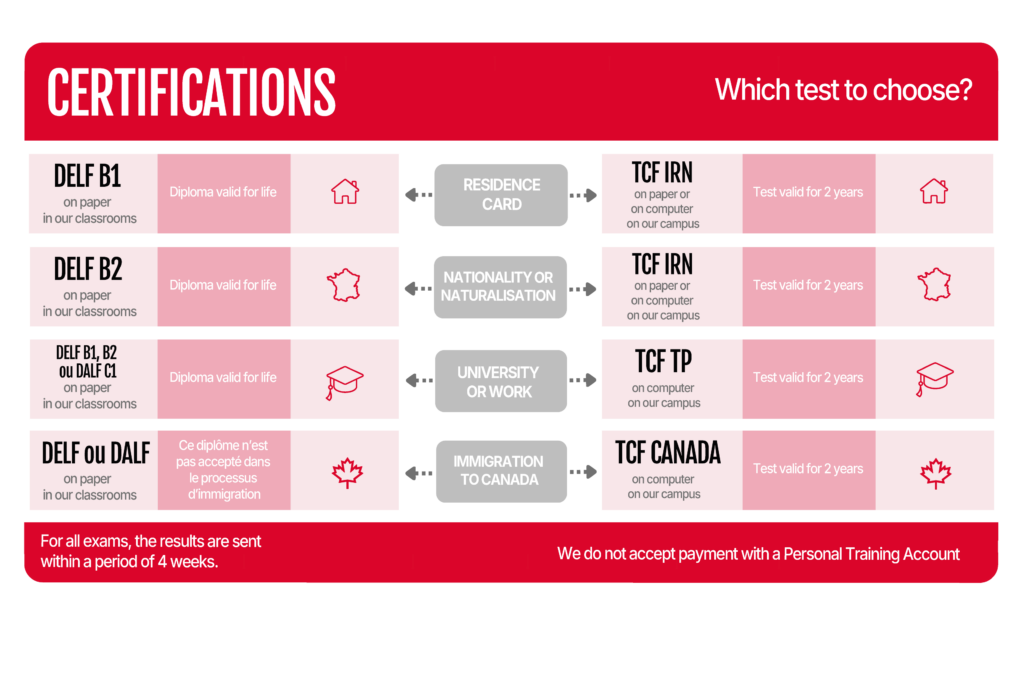
- DELF B2 or higher (valid for life)
- TCF IRN with a B2 score (valid for less than 2 years)
- A French diploma at level 3 or higher
The Alliance Française de Lyon is an official test center for the DELF and TCF exams. Check the exam schedule.
⚠️ Requirements may change, so always check official sources. on Service-Public.fr.
8. What level is needed to work in France?
The required level depends on the job and sector. Generally, B1 is the minimum level for working in France. Jobs involving public interaction or frequent writing often require B2.
To enter a French university, a B2 level is required. Most institutions require a DELF B2 or equivalent TCF score.
10. Certifications and French projects
France Éducation International delivers official French language certifications worldwide through more than 1,200 examination centers.
The Alliance Française de Lyon offers a comparison table to help guide you in choosing your exam:
Conclusion
Whatever your starting point, learning French is a progressive and personalized journey. The CEFR levels provide reliable benchmarks to help you move forward step by step, at your own pace.
Assessing your level, maintaining consistent effort, and receiving appropriate guidance are the keys to lasting progress.
If you would like support, teaching teams can guide you from A1 to C2 with tailored assessments and personalized learning paths.